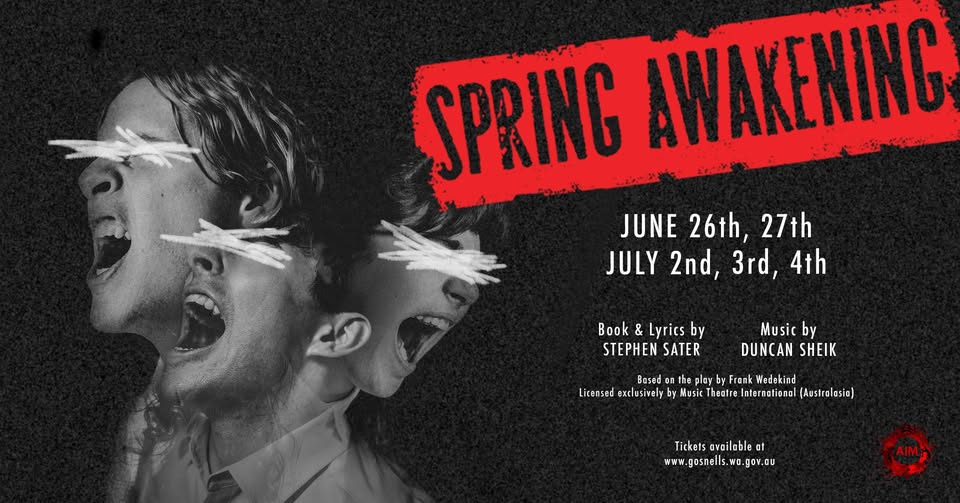
The energy in the room was undeniably high for Art In Motion’s closing night of Spring Awakening, highlighting both the enduring relevance of the text and the unique challenges of staging it.
The set design was effective, providing a smart, practical layout that allowed for quick, fluid scene changes. Although the stage was small, the production made excellent use of different levels, and while the space became crowded when the entire cast was on stage, the blocking worked well and the choreographed movement felt purposeful and instrumental in driving the story forward. A particularly strong choice occurred during the first school scene, where the male students were staged with their backs to the audience while enduring their lessons. This effectively created a sense of erasure, illustrating that they were not individual students but a conforming collective bound by societal rules. Meanwhile, the female students were isolated outside learning ‘female’ things, further highlighting the rigid enforcement of these societal norms.
This sense of restriction was reinforced by the costume and lighting design, which leaned into a deliberate lack of colour for most of the show. By keeping the wardrobe rooted in a bleak, muted palette, the design underscored the oppressive conformity of the characters’ world. This restraint paired beautifully with the lighting design, which succeeded in injecting mood and telling the story where the physical world remained grey and was especially powerful in capturing the dramatic weight of Moritz’s death, utilising great timing by both the cast member and crew to make that tragic moment land with full impact. This visual restraint paid off in the final scene; after an evening of winter darkness, the cast finally emerged in vibrant colours for The Song of Purple Summer, providing a visually stunning and hopeful release from the heavy world they had built.
Musically, the production soared highest when the company operated as a single unit. The big ensemble numbers, culminating in a spectacular final piece, were a definitive highlight of the evening, showcasing remarkably tight, rich harmonies. However, this vocal cohesion occasionally clashed with technical hurdles from the pit. There was a persistent, noticeable disconnect with the band (particularly within the violin line) that seemed to throw off the pitch and confidence of some of the vocalists. The drums were also far too loud in several moments, making it difficult to hear the cast and stripping away the emotional gravity of the scenes. With a relatively small band, careful mixing is absolutely vital; given the balance issues, it perhaps would have been better to position the musicians somewhere else rather than directly between the stage and the audience. While the enunciation was clear during the spoken dialogue, a lot of the lyrical content was lost during the musical numbers. While the ensemble found their collective strength, several of the soloists have yet to fully discover their own unique vocal identities, occasionally leaning into delivery that felt a bit too much like a carbon copy of the original cast album. In saying that, the duet between Ilse and Martha provided a standout musical moment, as did The Song of Purple Summer.
This text remains a deeply important and highly relevant story to tell at this point in time, yet the actual weight of the narrative was occasionally undermined. Some of the direction and acting choices suggested that the true gravity of the text was not completely understood, which unfortunately kept the production from being as powerful as it should have been. While there were some funny moments, some parts were played far too goofy and comedically, prompting frequent giggling from the audience that stripped away the necessary drama and seriousness. The book itself is not the most cleanly written, and despite having seen the show before, there were still moments (particularly near the end) where the plot was difficult to follow.
This issue was highlighted with the structural pacing. Likely a fault of how the show is written rather than the cast, the action frequently ground to a halt for musical numbers rather than allowing the music to flow naturally and elevate the story. The audience also seemed to miss the point of the narrative at times, treating the performance like a concert by applauding after each song and pulling the action to a stop. Managing this tension ultimately falls on the director’s shoulders; the pacing should have been tight enough to deny the audience the opportunity to stop the show, keeping the dramatic momentum building straight into the next part of the scene.
The production stumbled further in its consistency of detail, particularly regarding diction and specific creative choices. For a show rooted in classical academia, the Latin and German pronunciations (including the names of the characters themselves) were shaky and acted as a frequent distraction from the drama. Directorial choices also raised some questions: the decision to have the teacher be the sole character utilising a German accent felt entirely isolated. If the intent was to draw a stark line between the rigid older generation and the youth, it begged the question of why this choice wasn’t applied universally across all the adult roles.
While the production occasionally struggled to maintain the narrative’s true dramatic gravity, the undeniable commitment of the entire company ensured it remained an engaging night of theatre.
Please note: the writer has previously worked with a number of members of this cast and production team. Image sourced from Art in Motion.
Spring Awakening – Presented by Art in Motion
June 26 – July 4 2026